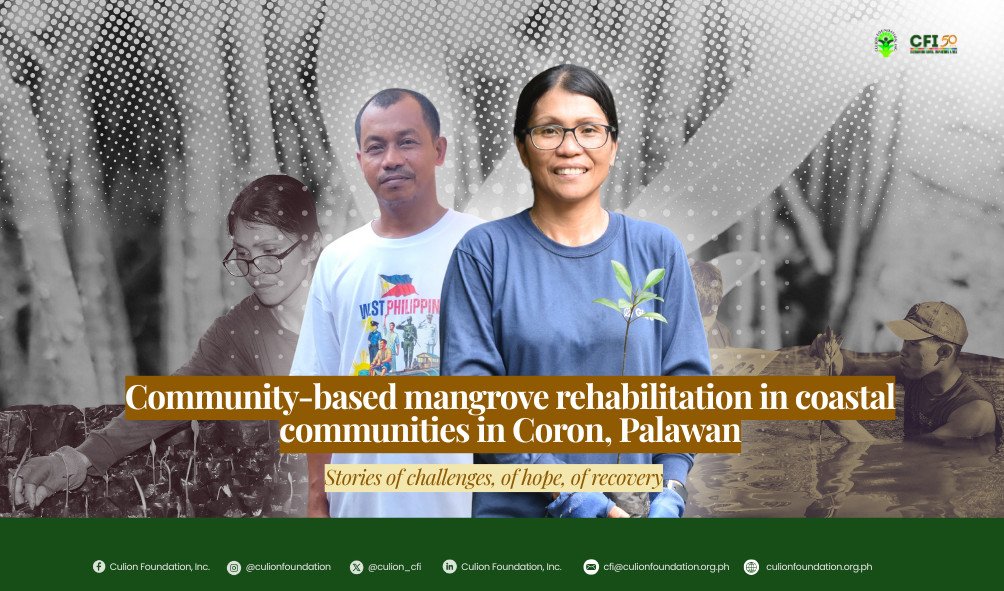
In the coastal areas of Coron, Palawan, fishing has long been a lifeline, a way of living passed down through generations. But in recent years, that lifeline has frayed. The ocean, once teeming with fish, has grown silent. Fisherfolk like Daniel Javier of Barangay Turda have found themselves returning from the sea empty-handed, their nets bare and their hopes dimmed.
Illegal fishing, deforestation, and the growing threat of climate change have all taken their toll. For many, the struggle to survive became even more dire during the COVID-19 pandemic. Despite these setbacks, stories and efforts to restore and protect coastal ecosystems have quietly gained momentum and offered a path toward recovery.
Planting a Solution: Mangroves as a Lifeline
For Daniel Javier, the Chairperson of the Municipal Fisheries and Aquatic Resources Management Council (MFARMC) in Brgy. Turda, change began in 2017 with the FishRight Project USAID-funded initiative. Initially involved in training sessions and community monitoring against illegal activities, Javier witnessed the shift from enforcement to restoration when mangrove reforestation was introduced. The mangrove initiative was then further sustained through the collaboration of CFI with G-Xchange, Inc. (GXI) and its GForest app, a sustainability initiative within the GCash mobile wallet app in the Philippines.
As 15,500 mangrove seedlings took root across 6 hectares of coastal areas, marine life slowly returned. Fish, crustaceans, and shellfish began thriving among the roots, offering an alternative for fishermen like him, especially vital when strong amihan winds made fishing impossible.
The routine now involves tending to the seedlings: clearing debris, monitoring for algae, and rescuing those stressed by storms. It’s not an easy task, but for Daniel, it’s deeply rewarding
A Woman’s Place is in Conservation
In Sitio Balinsungan, Barangay Tagumpay, another transformation quietly took root.
Imelda Mazo, President of the Shalom Women’s Biodiversity Conservation Association, is no stranger to struggle or to growth. When asked if her group could manage a protected area, their response was simple and determined: “We can do it.”
With support from CFI and other stakeholders, they trained in mangrove nursery management, breathing life back into a failed marine reserve. Today, this once struggling patch of coastline thrives as a Women-Managed Marine Protected Area, a living testament to resilience and recovery.
The mangroves brought more than just ecological recovery. They became a refuge.
“During the pandemic, this place became our home,” she says. “Even just watering the seedlings helped us cope. It gave us something meaningful to do.”
Their perseverance has not gone unnoticed. The group has earned awards like the Pearl Award and Para El Mar, secured grants, and even launched a rice retail project. These were all born from small beginnings and a steadfast commitment to environmental conservation.
“Back then, even though the income was just enough for us, I keep on telling and encouraging my colleagues, let’s be patient. If we keep dreaming, blessings will come.” Imelda shares, her face glowing with pride.
Bridging Communities and Nature
Both Daniel and Imelda understood that true conservation means collaboration, not conflict.
In Turda, Daniel noticed some being cut for building materials when other options, like mountain logs, weren’t available. Instead of confrontation, he chose a path of understanding. They spoke to the community, shared knowledge about the role of mangroves in coastal protection, and invited them to be part of the solution.
“We understand that there’s no law against cutting mangroves here yet,” he says. “So, we explained why they [the Tagbanuas] matter in terms of mangrove rehabilitation and encouraged them to join the project.”
In Sitio Balinsungan, Imelda took a similar approach, focusing on those directly impacting the coastline.
“We started with the violators,” she explains. “Now, they’re the ones helping us, because they’ve come to understand the value of the mangroves.”
What emerged was a powerful and inclusive conservation movement, where former violators transformed into dedicated protectors of the environment. This effort is part of CFI’s broader initiative to convert violators into eco-warriors. To date, CFI has trained over 60 eco-warriors, empowering them to become stewards of their communities and the natural resources they depend on.
Mapping Mangrove Survival
Mangrove restoration in Coron, Palawan, has taken root through the collective efforts of CFI, G-Xchange, Inc. (GXI), FishRight project, local government unit (LGU), Marine Protected Area (MPA) management teams, women’s groups, fisherfolk organizations, Indigenous cultural communities, youth associations, and other coastal stakeholders. At the forefront are leaders like Daniel and Imelda, whose commitment has ensured the sustainability of these vital ecosystems.
In Barangay Turda, a total of 15,500 mangrove seedlings were planted across a 6-hectare MPA, achieving an impressive 97% survival rate, thanks to the dedicated work of 20 local planters (8 male and 12 female).
In Barangay Tagumpay, the WMA-MPA in Sitio Balinsungan led the planting of 17,500 seedlings across a 7-hectare MPA. reaching a 96% survival rate, supported by 21 committed planters (5 male and 16 female, of which 15 are IPs).
Across six other barangays in Coron, including Turda and Tagumpay, a total of 125,000 mangrove seedlings now stands tall in 50 hectares of MPA, tended by 165 local planters (62 male and 103 female, of which 92 are IPs). These efforts, part of the Community-Based Mangrove Reforestation Project, have also achieved a remarkable 96% survival rate, reflecting the community’s deep-rooted commitment to coastal restoration.
Beyond Mangrove Rehabilitation
“Because of the incentives I earned as a mangrove planter, I was able to repair our home, invest to buy a motor for my boat, and even purchased gadget, like cellphone,” Daniel shared. “These might seem simple, but to us, they mean a better life
Mangrove reforestation activities didn’t just help him survive tough times; it gave him a new identity. No longer just a fisherman, Daniel became a steward of his coastline, leading his community to protect and nurture their mangrove nursery. He monitors seedlings, clears debris, and teaches others, including indigenous cultural communities, about the vital role of mangroves, supported by his colleagues and CFI.
Meanwhile, Imelda shared that her group’s work opened doors they never imagined: recognition, grants, and a rice retail livelihood project for members. “Back then, our income was small,” she recalled. “But I kept telling my fellow women, ‘Let’s be patient. If we keep dreaming, blessings will come.’”
Daniel and Imelda are proof that stories of hope and recovery don’t always come from institutions or grand policies, but rather, they grow from within people. Their stories remind us that when communities are empowered, when local knowledge is valued, and when small resources are matched with big trust, transformation happens.
They’re not just protecting mangroves, they’re rebuilding futures.
As Daniel puts it, “Mangroves are like people. When they’re cared for, they grow strong.”
And so do the people who care for them.