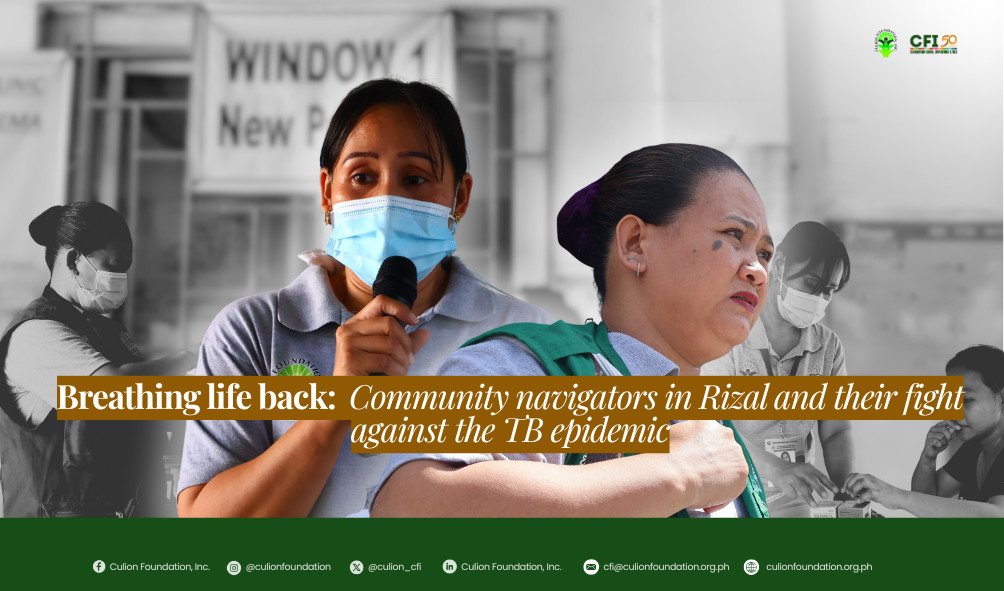
In the quiet barangay of San Isidro, nestled in Rodriguez, Rizal, the threat of tuberculosis (TB) is not just a health concern but also a social challenge. The remote location, limited access to quality health services, and persistent stigma and discrimination surrounding the disease make the area a difficult battleground for TB control and elimination. In this setting, two women, Mary Jane Sugi and Nieva Odad, have emerged as unlikely but powerful forces for change.
Before stepping into their roles as Community Navigators under the Oplan Manunuyod Project, both Mary Jane and Nieva lived lives shaped by limitation and isolation. Mary Jane Sugi, 43, a solo parent caring for a special needs child and 3 other children, and an aging father, worked as a massage therapist, struggling to make ends meet, especially after mortgaging her home to help cover her daughter’s hospital bills. Nieva Odad, 42, a mother and a housewife, rarely spoke in public and avoided community engagement due to introversion. Neither imagined that one day they would be trekking steep hillsides and knocking on doors and families to talk about tuberculosis (TB).
Their journey began with an introduction of the Oplan Manunuyod Project, an initiative implemented by Culion Foundation, Inc. (CFI) through the support of Fundacion Vicente Ferrer (FVF) and in partnership with Montalban Laban Lungs Philippines (MLLP), and the local government unit of Rodriguez, Rizal. To improve TB preventive treatment enrolment in the municipality, the project engaged MLLP and capacitated its members on how to become effective community navigators. The trainees include Mary Jane and Nieva. At the start, the two have very little understanding of TB. Mary Jane viewed it as a dangerous and contagious illness, while Nieva knew only that it spread through the air. But through intensive training and mentorship from CFI, they gained more than just scientific knowledge; they learned how to become effective advocates for their communities. “With the help of these trainings, we learned how to protect ourselves and educate others,” Mary Jane said. “Now. We don’t just inform, but we also empower.”
Going the Extra Mile
Their days soon filled with house visits, TB screening referrals, patient follow-ups, and health education sessions. With flipcharts in hand, they ventured into the rugged terrain of their community, facing more than physical obstacles. “One time, we were almost pushed off a mountainside by a truck. It was scary, but we kept going,” Mary Jane recalled. They faced suspicion, rejection, and resistance. Some patients clung to herbal cures or divine healing. Others were afraid of skin tests or discouraged by the side effects of medication. Still, the women pressed on. “Because of the knowledge we shared, they kept going and finished their treatment. That was a win for all of us,” Nieva said.
Their efforts didn’t just touch lives, but they reshaped public health outcomes. In just four months, from September to December, the impact of Mary Jane, Nieva, and their fellow Community Navigators could be seen clearly in the data collected and reported by the LGU. In the municipality, three Rural Health Units (RHUs) were closely monitored during this period, and each reflected the growing reach of community-based advocacy.
Measurable Impact
Between September and December, the impact of the Community Navigators became clear. The number of individuals who underwent TB preventive treatment, the weakest link among all the TB program initiatives, did not just exceed the target; it did not just double or triple; it quadrupled.
At RHU I, of the 160 individuals enrolled in TB Preventive Treatment (TPT), 44 percent, or nearly half, were referred and convinced by Community Navigators. In another area covered by RHU III, 382 people were enrolled, and Community Navigators played a role in enrolling 184 of them, translating to 48 percent of the total.
But the most impressive results were seen at RHU II. Out of 362 patients enrolled in TPT, an overwhelming 74 percent, a clear majority, started treatment because of the direct efforts of the Community Navigators. Their active presence in the field, their personal connection and persistence in communicating with hesitant families, and their ability to earn trust translated directly into patient enrollments.
All together, these efforts led to 904 people being enrolled in TPT across the three RHUs during the final quarter of the year. The 904 enrolled patients are the total 2024 accomplishment of the three RHUs in TPT. This feat of OMP is very impressive, as the community navigators contributed more than half of the 2024 annual accomplishment of the three RHUs in just a span of one quarter.
Beyond Numbers
These numbers are more than statistics; they are lives saved. Children, breadwinners, grandparents, and neighbors who now have a chance to have an improved health outcome. Behind them is the courage and care of two women who refused to stay silent.
Despite the challenges, their perseverance paid off in tangible ways. Equipped with accurate information from the TB 101 training and fortified by two hard-won emotional resiliencies, they have successfully guided countless patients to enroll in and complete TB Preventive Treatment. Mary Jane remembers convincing one particularly hesitant patient to undergo treatment. This is an experience she describes as “worth everything.”
The impact of their work rippled beyond public health. It changed their personal lives as well. For Mary Jane, the project was a financial lifeline. With her modest earnings from CFI, she finally began to save enough to redeem her mortgaged home and even planned to open a small Salon and Spa business beside it. “After four years, I’m reclaiming my house. The allowance I received from the project really means everything to me,” she said.
Nieva, too, felt the transformation. The allowance she receives helps her and her husband manage household expenses and fund their children’s education. But more than financial support, Oplan Manunuyod gave her a voice. “I’ve grown so much, from someone who barely spoke to someone who now leads health education and contact investigations,” she said.
Real Change, Real People
As Community Navigators, Mary Jane and Nieva do more than monitor health—they mend trust, shift mindsets, and inspire behavior change. Their work is a testament to the quiet power of grassroots advocacy. “Even if the project ends, I’ll keep doing this,” Mary Jane said. “This has become my advocacy; it is not just work anymore. It’s our passion.”
In the national and local fight against TB, statistics and strategies are essential, but they do not tell the whole story. Real transformation comes from the ground up, from women like Mary Jane and Nieva, whose courage and commitment breathe life back into their communities, carrying life-saving messages to the farthest homes and hardest hearts.
September 1, 2025
Breathing life back: Community navigators in Rizal and their fight against the TB epidemic
In the quiet barangay of San Isidro, nestled in Rodriguez, Rizal, the threat of tuberculosis (TB) is not just a health concern but also a social challenge. The remote location, limited access to quality health services, and persistent stigma and discrimination surrounding the disease make the area a difficult battleground for TB control and elimination. In this setting, two women, Mary Jane Sugi and Nieva Odad, have emerged as unlikely but powerful forces for change.